
Climate vulnerable countries assert carbon markets leadership
Climate vulnerable countries showcased landmark carbon markets milestones on the sidelines of the IMF-World Bank Spring Meetings.
23 April, Washington DC, USA — Climate-vulnerable nations from across Africa, Asia, the Caribbean, Latin America, and the Pacific convened to spotlight concrete steps they are taking to harness high-integrity carbon markets as a driver of economic resilience and climate prosperity, demonstrating that they are not waiting for climate finance to arrive, but actively building the architecture to attract it.
The event was convened by the Climate Vulnerable Forum and V20 Finance Ministers (CVF-V20) and VCMI on the sidelines of the Spring Meetings of the World Bank and the International Monetary Fund (IMF).
Ambassador H.E. The Most Honourable Elizabeth Thompson, Sherpa to Prime Minister Mia Amor Mottley of Barbados, Chair of the CVF-V20, set the tone for the discussions, underscoring that carbon finance is one of the super levers to catalyze finance in climate-vulnerable countries, with the potential to “unlock an additional US$20 billion by 2030, which can be used to support the climate prosperity agenda and boost nature-based solution investments.”
CVF-V20 Nations Showcasing Action
Earlier this year, Bhutan launched the Carbon Market Information Platform, designed to enhance transparency, reduce transaction costs, and strengthen carbon credit integrity. The platform includes a first-of-its-kind, interactive private sector engagement manual to help private participants navigate key sections of Bhutan’s carbon market guidance.
“Bhutan’s approach focuses on bridging the gap between frameworks and a functioning market by developing a credible pipeline of activities, strengthening institutional coordination, and engaging early with sovereign and private sector buyers,” H.E. Lyonpo Lekey Dorji, the Minister of Finance of The Kingdom of Bhutan, said.
Ghana is among the most advanced CVF-V20 countries at mobilizing finance under Article 6 of the Paris Agreement.
“Several projects on the National Carbon Market Pipeline include Ghana Forest Investment Program which is expected to generate 10 million carbon credits, the Ghana REDD+ Program which targets 5 million carbon credits, and the Solar Irrigation Project which is estimated to gain two million carbon credits,” H.E. Issifu Seidu, the Minister of State for Climate Change and Sustainability of the Republic of Ghana, cited.
H.E. Tiaone Hendry, Chairperson of the Natural Resources, Energy and Climate Change Committee of the Parliament of Malawi, stressed that strong legislative foundations are non-negotiable as carbon projects begin to scale in her country. “Parliamentary engagement is not optional. It is essential,” she said, noting the ongoing questions around legal frameworks, benefit-sharing, and community rights.
The esteemed parliamentarian made it clear, “Success will not be measured by the number of carbon credits generated. It will be measured by whether livelihoods are improved, whether communities see tangible benefits, and whether revenues are clearly contributing to national development.” She warned about avoiding a situation where carbon becomes another extractive industry, and highlighted the vital role of parliamentarians to ensure the interests of their constituents are heard in emerging legislation.
Mr. John Narag, Director at the Philippines’ Department of Finance, presented the country’s newly adopted Roadmap to Readiness in the Voluntary Forest Carbon Market, establishing a strategic framework spanning policy development, data analytics, institutional mechanisms, and sustainable financing for forest carbon. He also shared that the Philippines, as the current ASEAN Chairman, will host a Carbon Market Forum for the region in September 2026 to help advance carbon market initiatives across the country and the wider region.
Pakistan, meanwhile, announced the signing of its first-ever carbon market deal—another milestone following the launch of its National Policy Guidelines for Trading in Carbon Markets. Zulfiqar Younas, Additional Secretary and Member of the Federal Board of Revenue in Pakistan, highlighted the country’s plans to scale investment-ready project pipelines across key sectors, including water, transport, industry, agriculture, forestry, and other land uses.
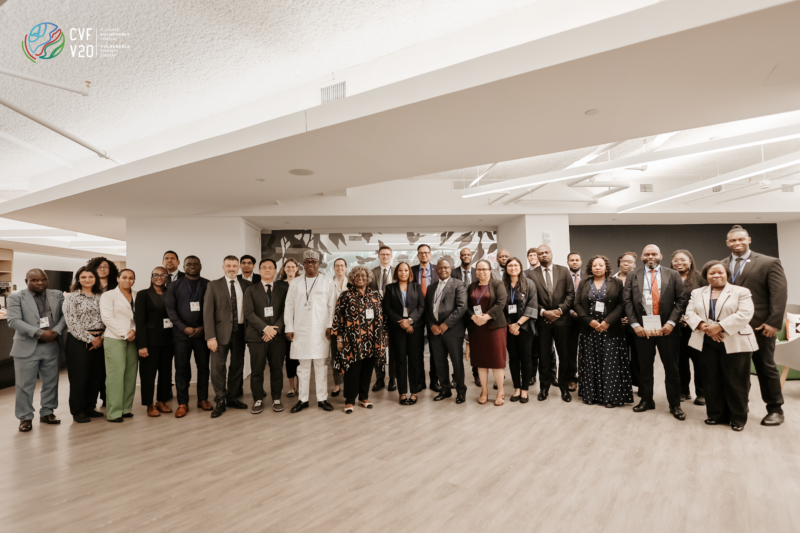
Participants at the Carbon Finance Program workshop
Addressing Bottlenecks, Enabling Market Conditions
Despite rising momentum, significant barriers remain. The 45 least developed countries globally accounted for just 1.5 percent of all projects registered under the Clean Development Mechanism. Without significant technical support, there is a significant risk that this pattern will repeat under Article 6, with those countries that most need the carbon market finance that is available unable to access it. Discussions identified low technical capacities, fragmented institutional uptake and coordination, accounting challenges, regulatory uncertainty, and social safeguards as the principal constraints holding both countries and private sector investors back.
”Countries need to take ownership of carbon market initiatives. An appropriate legislative framework and fiscal infrastructure are needed to ensure efficiency in carbon market engagement and management,” Sara Jane Ahmed, Managing Director and Finance Advisor of the CVF-V20 Secretariat, said.
The technical session, the first of three to be delivered this year, examined what policy and regulatory conditions are needed to unlock Article 6 and voluntary demand for high-integrity carbon credits at scale.
“The world cannot achieve its climate targets without dramatically scaling up flows of finance to climate-vulnerable nations. As carbon markets grow, it is vital that climate-vulnerable nations are well equipped to leverage these channels of finance to support domestic priorities and global goals. VCMI’s partnership with the CVF-V20 is already building the foundations for high-integrity carbon markets that support climate prosperity across the CVF-V20 membership,” Mark Kenber, Executive Director of VCMI, said.
VCMI has launched the Carbon Markets Access Toolkit that political leaders and key market actors from host countries can use to decide whether and how to engage with regulated and voluntary carbon markets, as well as those facilitated under Article 6 of the Paris Agreement.
As the global carbon market continues to grow, the CVF-V20 Secretariat and VCMI will continue empowering climate-vulnerable countries with knowledge, tools, and capacity-building activities on the development of robust carbon market infrastructure that attracts investment.
Notes to editor
- This event forms part of the workshop series under VCMI and CVF-V20’s Carbon Finance Program, designed to support CVF-V20 member countries in leveraging high-integrity carbon markets to finance their Nationally Determined Contributions (NDCs) and Climate Prosperity Plans (CPPs).
- CPPs are nationally owned multi-phase investment strategies that reframe climate vulnerability as a socio-economic and development challenge that can be solved through well-structured, growth-generating investment. They are built around bankable pipelines of investment opportunities, grounded in macroeconomic realities and implemented through delivery structures known as Country Platforms, typically anchored in Ministries of Finance. These platforms coordinate line ministries, development banks, and capital mobilization institutions under a single architecture.
- With 83 percent of NDCs expressing interest in international market mechanisms, Article 6 of the Paris Agreement is emerging as a critical enabler for raising climate ambitions. Scaling carbon markets through high-integrity projects could halve the cost of capital needed to implement NDCs, CPPs, and broader development plans.
- A 2025 report by CVF-V20 and Bridgetown Initiative identified ten ‘super levers’ that will create multiplier effects, mobilising hundreds of billions of dollars of desperately-needed financial resources to countries on the frontlines of the climate crisis. One of these super levers is scaling and standardizing carbon markets by implementing high-integrity carbon pricing in ways that help protect and enhance nature, including a robust Article 6 mechanism and G20 countries purchasing international credits to raise carbon market funds for vulnerable countries.